
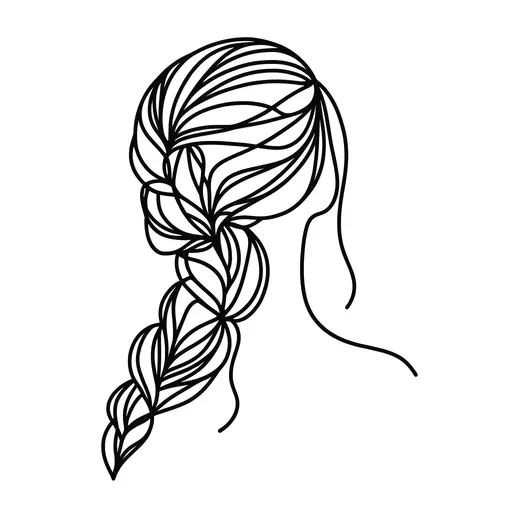
How to draw ...
braids
braids is the 66th most searched thing that people want to draw and here is how it compares to other things in People > Expressions.
But do people always want to draw braids?
Interest over time on "how to draw braids" in the U.S.
Cycle
Search volume shows a recurrent spike around September and December, potentially indicating a trend associated with fashion cycles or holiday styling preferences.
And how does it compare to the most popular things to draw among Expressions?
Interest over time on "how to draw braids" comparing to top 3 in Expressions category
data from Ahrefs Keyword ExplorerWhich countries are most interested in drawing braids?
| United States | 🇺🇸 | 143,000 | |
| Germany | 🇩🇪 | 23,000 | |
| United Kingdom | 🇬🇧 | 20,000 | |
| South Africa | 🇿🇦 | 19,000 | |
| Nigeria | 🇳🇬 | 9,100 |
How to draw braids step-by-step
Drawing braids requires managing the complexity of intertwined strands while maintaining clarity and coherence in the representation. One of the main challenges is accurately capturing the overlapping and twisting of strands in a manner that appears natural and consistent, which can be addressed through strategic use of line weight, shading, and attention to perspective. Additionally, creating a visually pleasing braid involves understanding the underlying pattern and rhythm of the twists, which can be enhanced by planning and sketching the basic structure before adding details and textures.
Here are the steps to drawing braids:
- Establish Guidelines: Begin by drawing three parallel, vertical lines on your paper. These lines will serve as guides to ensure that your braid remains consistent and uniform in width as it progresses.
- Draw the First Braid Strand: Starting at the top of the guidelines, sketch a curved line that crosses from the first guideline to the center guideline. This line should resemble an elongated "S" shape and will form the top of the first strand of the braid.
- Add the Second Strand: From the center guideline, draw another curved line that crosses over to the third guideline. This curve should also be 'S' shaped and cross under the first strand to create an interwoven look.
- Create the Third Strand: From the third guideline, draw a third curve that crosses over to the first guideline. This line should pass under the second strand and over the first, continuing the weaving pattern of the braid.
- Continue the Pattern: Keep repeating the pattern, alternating the direction of each new curved line in an 'over-under' sequence. Every time a line crosses over another, make it appear as if it is going underneath the previous one, to give the illusion of a woven braid.
- Refine the Braid: Once you reach the desired length, go back and refine the braid curves, adding slight tapering at the ends to achieve a more natural look. Adjust each curve where necessary to ensure the braid is even and cohesive.
- Add Details and Texture: Enhance the appearance of your braid by adding small, curved lines along each strand to mimic the texture of hair. These lines should follow the direction of the braid's curve to enhance realism and depth.
- Erase Guidelines: Carefully erase the original guidelines and any unnecessary sketch lines, making sure not to erase the braid itself. This will give the braid a clean, finished look.
- Finalize with Shading: To achieve a more realistic effect, add shading to the intersecting areas of each strand to emphasize the overlapping pattern. Darken the areas where strands go under and lighten the parts that come over, enhancing the dimensionality of your drawing.
Common mistakes
- Overlapping Strands Incorrectly: Many artists inadvertently draw strands of the braid crossing each other at incorrect angles, which disrupts the natural flow and symmetry of the braid pattern.
- Inconsistent Strand Thickness: It's common for artists to draw strands with varying thicknesses within a single braid, making the braid look uneven rather than neatly interwoven.
- Imperfect Strand Spacing: Failing to maintain consistent spacing between the strands can result in a braid that appears either too tight in places or irregularly spaced, disrupting the visual harmony of the design.