
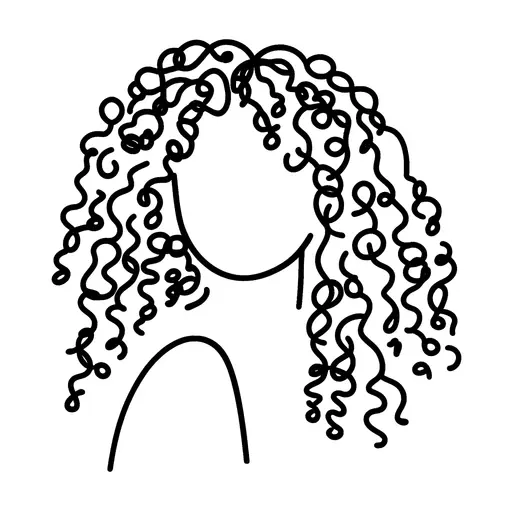
How to draw ...
curly hair
curly hair is the 76th most searched thing that people want to draw and here is how it compares to other things in People > Expressions.
But do people always want to draw curly hair?
Interest over time on "how to draw curly hair" in the U.S.
Anomaly
Significant peak in search volume in April 2020, possibly linked to increased interest in personal care and hairstyling during early COVID-19 lockdowns.
And how does it compare to the most popular things to draw among Expressions?
Interest over time on "how to draw curly hair" comparing to top 3 in Expressions category
data from Ahrefs Keyword ExplorerWhich countries are most interested in drawing curly hair?
| United States | 🇺🇸 | 94,000 | |
| India | 🇮🇳 | 34,000 | |
| United Kingdom | 🇬🇧 | 21,000 | |
| Philippines | 🇵🇭 | 11,000 | |
| Canada | 🇨🇦 | 10,000 |
How to draw curly hair step-by-step
Drawing curly hair presents distinct challenges due to its complex texture and volume, requiring attention to the diverse shapes and directions of curls. Artists must skillfully depict the natural bounce and irregularity of curls while maintaining coherence in the overall hairstyle. Strategies include breaking down the curls into simpler, overlapping shapes, using varied line thickness to suggest depth and texture, and incorporating highlights and shadows to accentuate the three-dimensionality of curly hair. Mastery of these techniques allows for a more dynamic and realistic representation of curly hair in artwork.
Here are the steps to drawing curly hair:
- Outline the Basic Shape: Start by sketching the overall form of the hairstyle lightly using a soft pencil. Determine where the hair will be positioned around the head, and draw rough lines that indicate how far and in what direction the curls will extend.
- Define Sections: Divide the hair into manageable sections, which will help in drawing the curls more accurately. This step is about understanding how different parts of the hair interact, so think about where the hair naturally parts and how it flows.
- Draw Basic Curl Patterns: Within each section, begin drawing loose, flowing 'S' or 'C' shapes to represent individual curls or strands. Keep your pencil strokes light and fluid, aiming for natural-looking curves. Remember, curls vary in size, so mix tighter and looser shapes for variety.
- Add Layers and Depth: Overlap some of the curls to create a sense of layering and depth. Use slightly darker pencil strokes to highlight the curls that are in front. This overlapping helps simulate the complexity and volume of curly hair.
- Emphasize Texture: Enhance the texture by adding more curls and details within each section. Pay attention to how light and shadow affect the hair's appearance. You can use slight variations in line weight—darker lines for shadows and lighter ones for highlights.
- Refine and Detail: Refine the curls by erasing unnecessary lines and sharpening the details. Make sure the curls are well-defined and natural-looking. Add additional lines if needed to indicate the direction and texture of the hair.
- Adjust Contrast and Shading: Use shading techniques to add dimension to the curls. Consider the light source and shade the areas where light doesn't hit directly. You can use softer strokes or a blending tool to smoothen and blend shades for a realistic effect.
- Final Touches: Review the entire drawing and add any last details to ensure cohesiveness. Make adjustments, define any loose ends, and ensure that the curls look balanced and proportional.
Common mistakes
- Flat Spirals: Treating curls as flat spirals rather than three-dimensional forms can lead to unrealistic hair. Curls should have volume and depth, with light and shadow to suggest their roundness.
- Uniform Curls: Drawing all curls the same size and shape results in unnatural hair. Curls typically vary in size, shape, and direction, reflecting natural diversity and movement.
- Lack of Layering: Failing to layer curls can make the hair look stiff and lifeless. Proper layering adds texture and dimensionality, giving the hair a more realistic and dynamic appearance.