
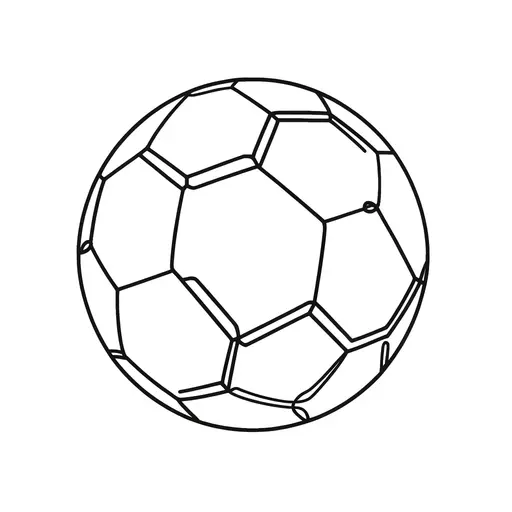
How to draw ...
a soccer ball
a soccer ball is the 54th most searched thing that people want to draw and here is how it compares to other things in Objects & Concepts > Other.
But do people always want to draw a soccer ball?
Interest over time on "how to draw a soccer ball" in the U.S.
Cycle
Search volume peaks annually around September due to specific events or trends that recur annually during this month.
And how does it compare to the most popular things to draw among Other?


Interest over time on "how to draw a soccer ball" comparing to top 3 in Other category
data from Ahrefs Keyword ExplorerWhich countries are most interested in drawing a soccer ball?
| United States | 🇺🇸 | 1,300 | |
| Canada | 🇨🇦 | 100 | |
| Australia | 🇦🇺 | 90 | |
| South Africa | 🇿🇦 | 70 | |
| United Kingdom | 🇬🇧 | 20 |
How to draw a soccer ball step-by-step
Drawing a soccer ball presents challenges primarily due to its geometric pattern and three-dimensional form. Accurately depicting the classic black and white pentagons and hexagons requires understanding the geometry of a truncated icosahedron. Capturing its spherical shape involves shading to convey dimension and depth. Effective strategies include starting with a light pencil sketch to outline the sphere and panels, utilizing reference images for accuracy, and applying shading techniques like cross-hatching or gradient shading to enhance realism.
Here are the steps to drawing a soccer ball:
- Create the Basic Circle: Start by drawing a perfect circle. This will form the outline of your soccer ball and serves as the base for the subsequent patterning.
- Draw a Hexagon in the Center: Inside the circle, sketch a regular hexagon. Make sure it's positioned centrally. This hexagon will be one of the black panels on the soccer ball.
- Add Surrounding Pentagons: Add five equally sized pentagons surrounding the central hexagon. These will be white panels. Ensure each side of the hexagon connects to a side of a pentagon.
- Complete the Pattern: Continue by adding additional hexagons and pentagons around the structure you've drawn. Remember, the pattern alternates between hexagons and pentagons to fit within the circular outline.
- Refine the Angles and Shapes: Carefully adjust the edges and angles to ensure that each polygon fits properly within the circle. Maintain consistent size and shape for a realistic appearance.
- Emphasize the Outline: Go over the main circle and polygon edges with a darker line or pen to make the structure of the soccer ball stand out. This helps to define the pattern clearly from a distance.
- Add Shading for a 3D Effect: To give the soccer ball a realistic look, add shading to the polygons. Shade the black hexagons fully and the white pentagons with light shading to suggest depth.
- Include Highlights and Textures: Lightly add highlights to suggest light reflection on the surface. You can also draw small textures or markings to indicate the texture of the material.
- Finalize with Detailing: Add any final details, such as branding, additional shading, or correction of lines. Ensure the soccer ball looks polished and three-dimensional.
Common mistakes
- Inaccurate Panel Shapes: Many assume that a soccer ball only consists of hexagons, whereas a traditional design includes a combination of hexagons and pentagons.
- Incorrect Panel Count: Some people mistakenly draw too few or too many panels. A classic soccer ball typically has 32 panels—20 hexagons and 12 pentagons.
- Uniform Panel Size: It’s a common error to draw all panels the same size, but on a real soccer ball, pentagons appear slightly smaller than hexagons to fit properly into the spherical shape.